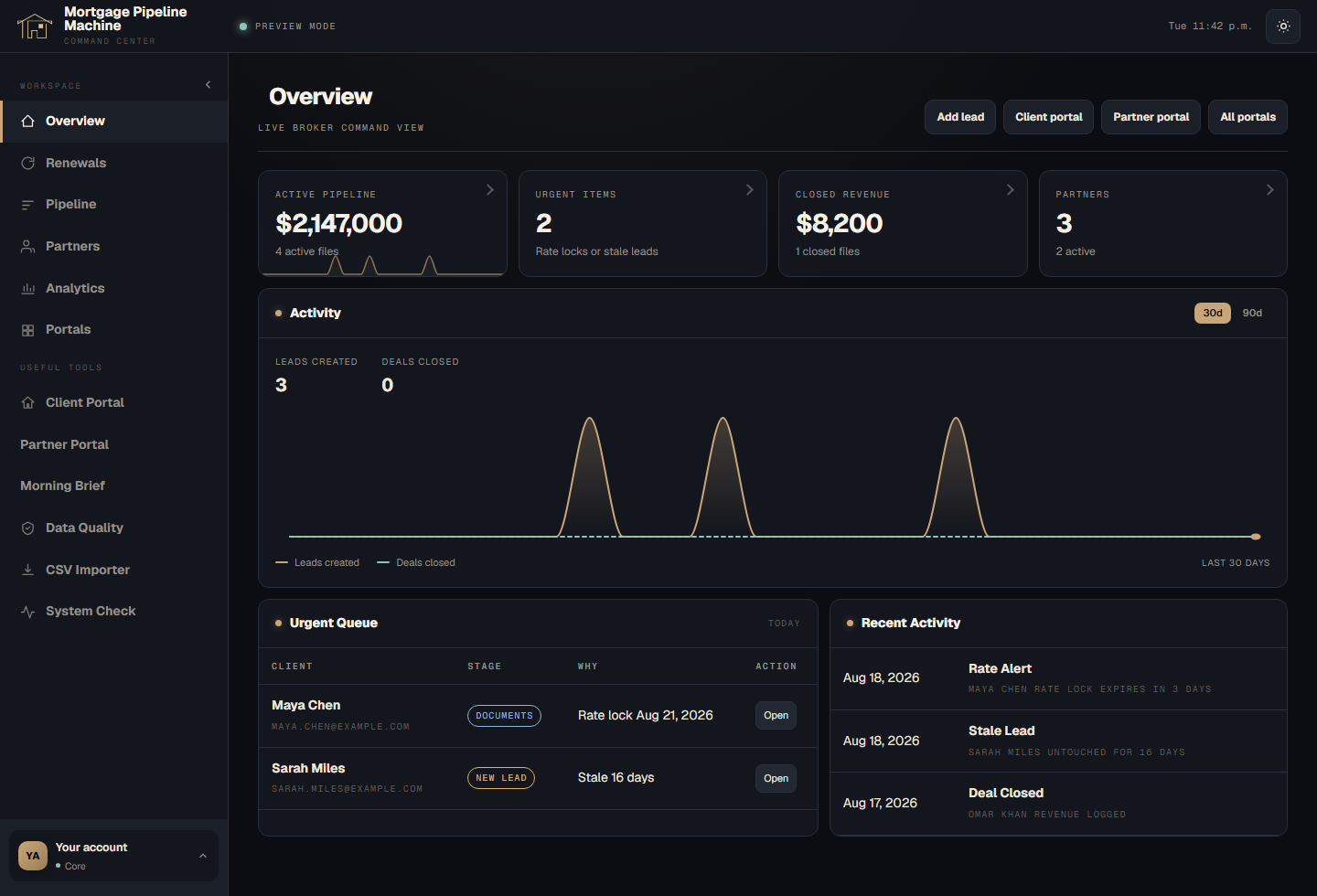
Mortgage Pipeline Machine finds the mortgages approaching renewal, shows which files are ready to work, flags the ones that need repair, and turns your existing book into a broker-reviewed weekly renewal plan.
This is what MPM does first: it tells you what is actually plannable before it prepares outreach.
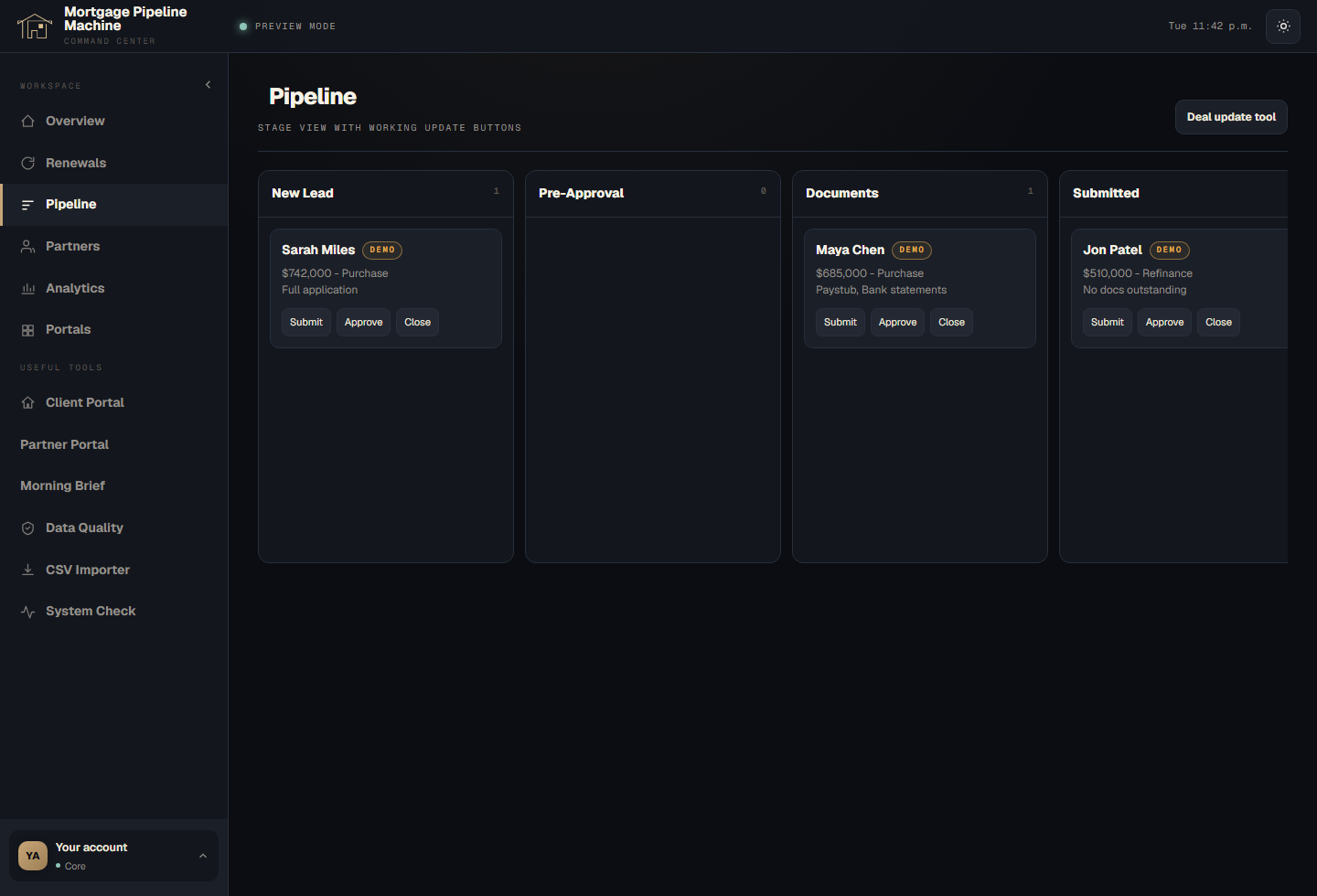
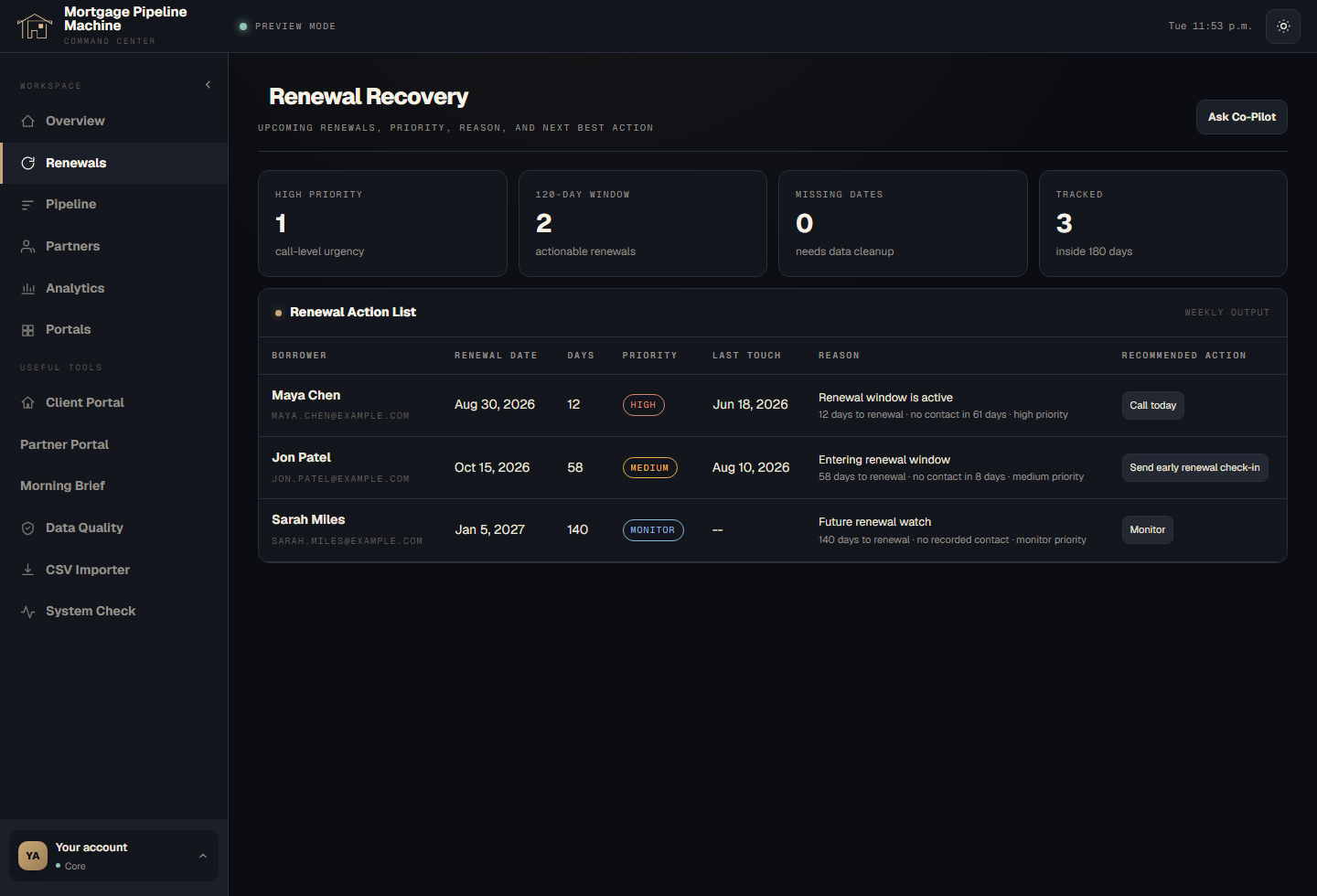
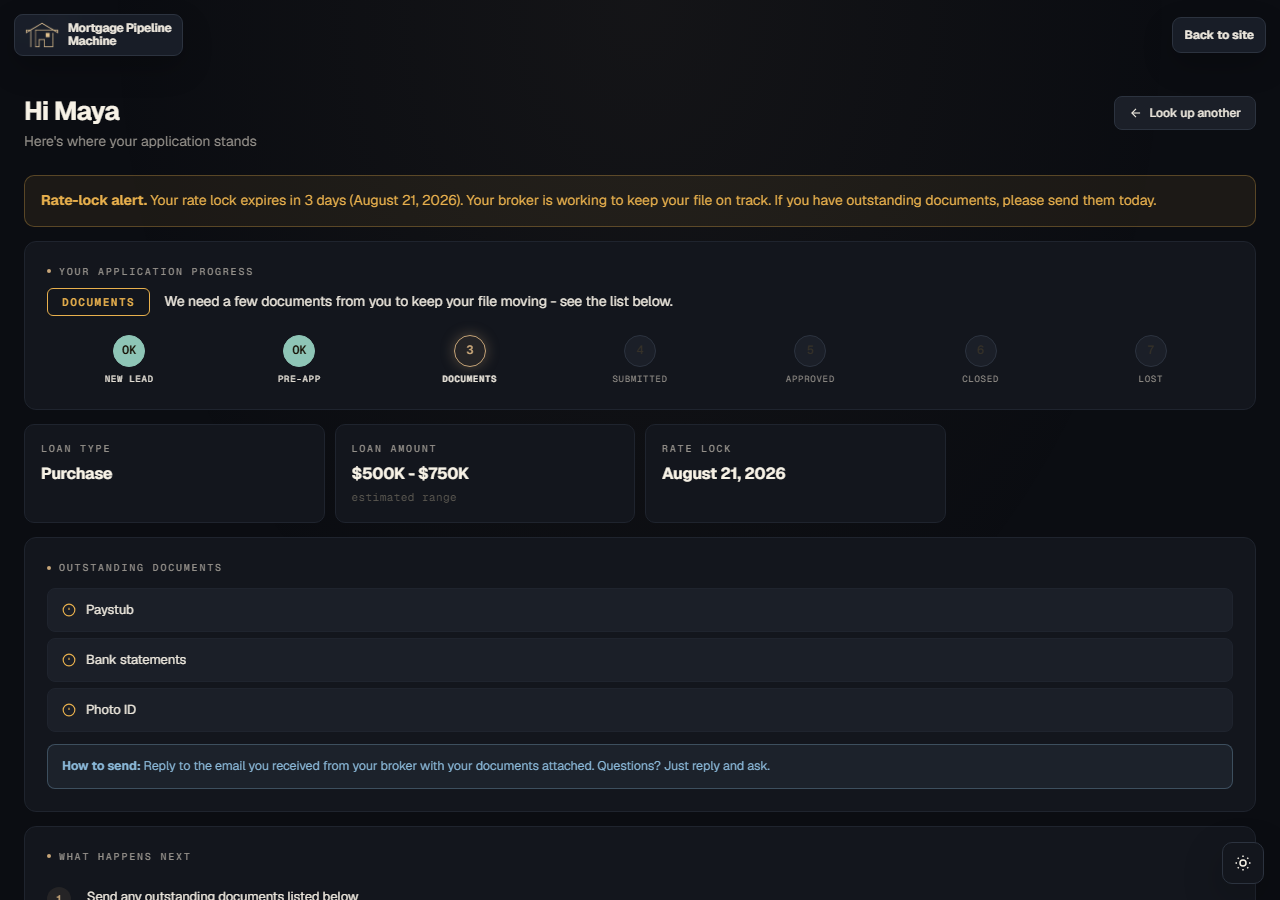
Illustrative product preview. Book metrics come from the synthetic demo workbook, never from a client. The live product keeps send control separate: the Draft Queue has no hidden mass-send path.
Every funded mortgage creates another future opportunity. But once the book gets large enough, memory stops working: renewal dates go missing, consent gets buried, follow-up starts late, and good files disappear inside spreadsheets and CRMs.
Missing or unusable dates make otherwise valuable records invisible to renewal planning.
Consent evidence and suppression signals live in different places, so the team either hesitates or moves without enough evidence.
The renewal was predictable. The workflow was not.
Without a weekly list and activity record, "we followed up" is difficult to manage or verify.
MPM evaluates the book you already have, shows the source-data gaps, prioritizes renewal opportunities, keeps broker approval in the loop, and turns the work into evidence.
Your CRM and workbook stay. MPM adds the recovery layer your existing systems are missing.
MPM evaluates the records you already have and identifies usable renewal timing, missing information, duplicates, and rows that need repair.
Consent and suppression rules run before a borrower becomes actionable. Missing information is not guessed and unknown consent is not treated as permission.
Every week, the brokerage sees who is approaching renewal, who is ready, who needs broker judgment, who is blocked, and why.
Your Google Sheets workbook stays the source of truth. MPM reads it and plans from it — your records never become hostage data inside a platform you cannot leave.
A database with 5,000 records is not automatically a 5,000-client renewal pipeline. Some records are complete. Some have broken dates, missing terms, duplicates, or source fields that need repair before the renewal can be planned.
The remaining gaps are not hidden. You get a correction file showing exactly what needs to be repaired, fix it at the source, re-import, and watch coverage improve.
The Command Center turns your covered book into four decisions: work it, review it, leave it alone, or repair it.
The Planner reads like a recovery queue, not a dashboard. Every borrower in the renewal window lands in exactly one state:
Nothing is sent from this review screen. An approved draft leaves by copy, into your own Gmail, under your own name.
MPM gives the owner visibility into upcoming renewals, completed actions, blocked records, pipeline activity, and recorded outcomes. Every borrower name and number on these screens is synthetic demo data — an illustrative product preview, never a client book.
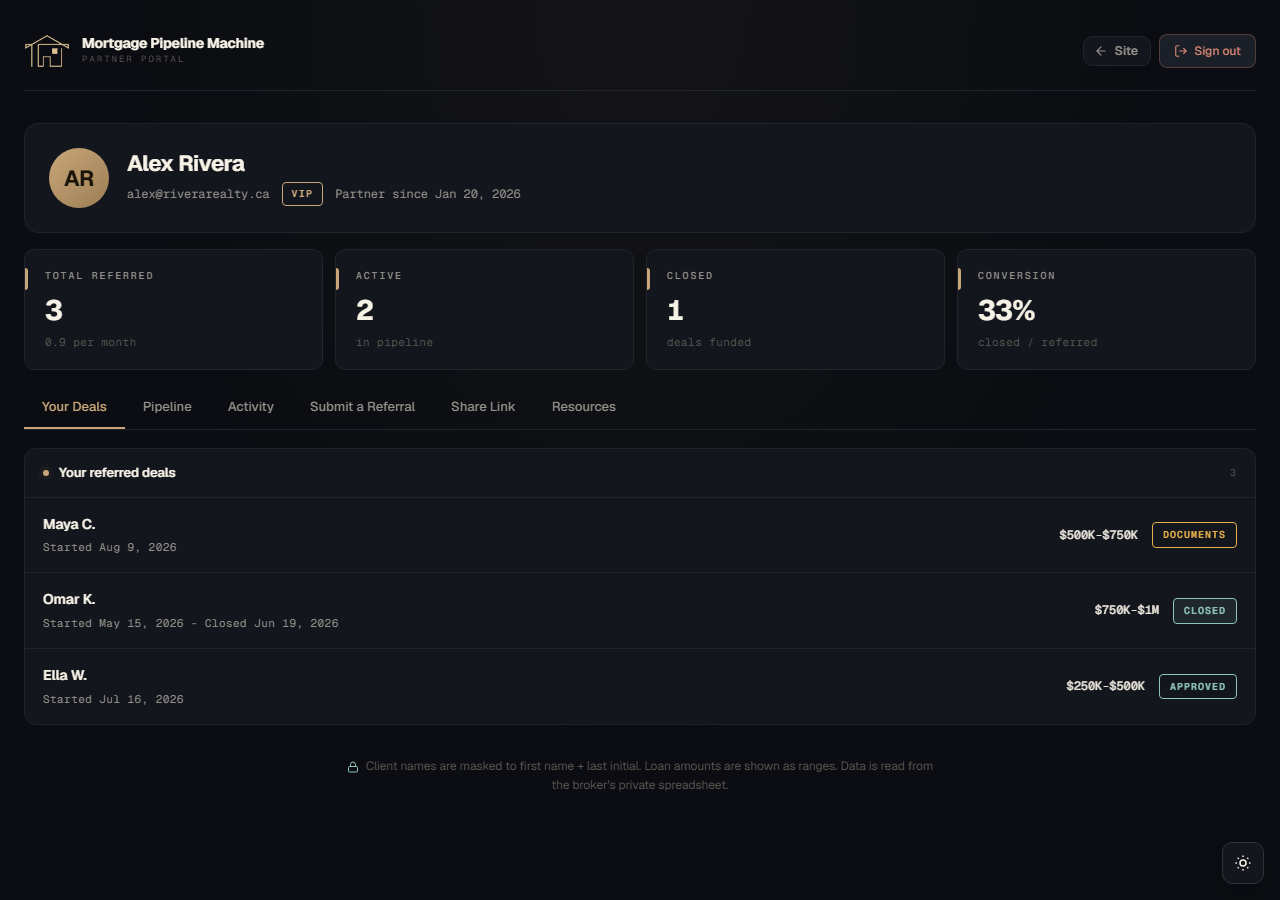
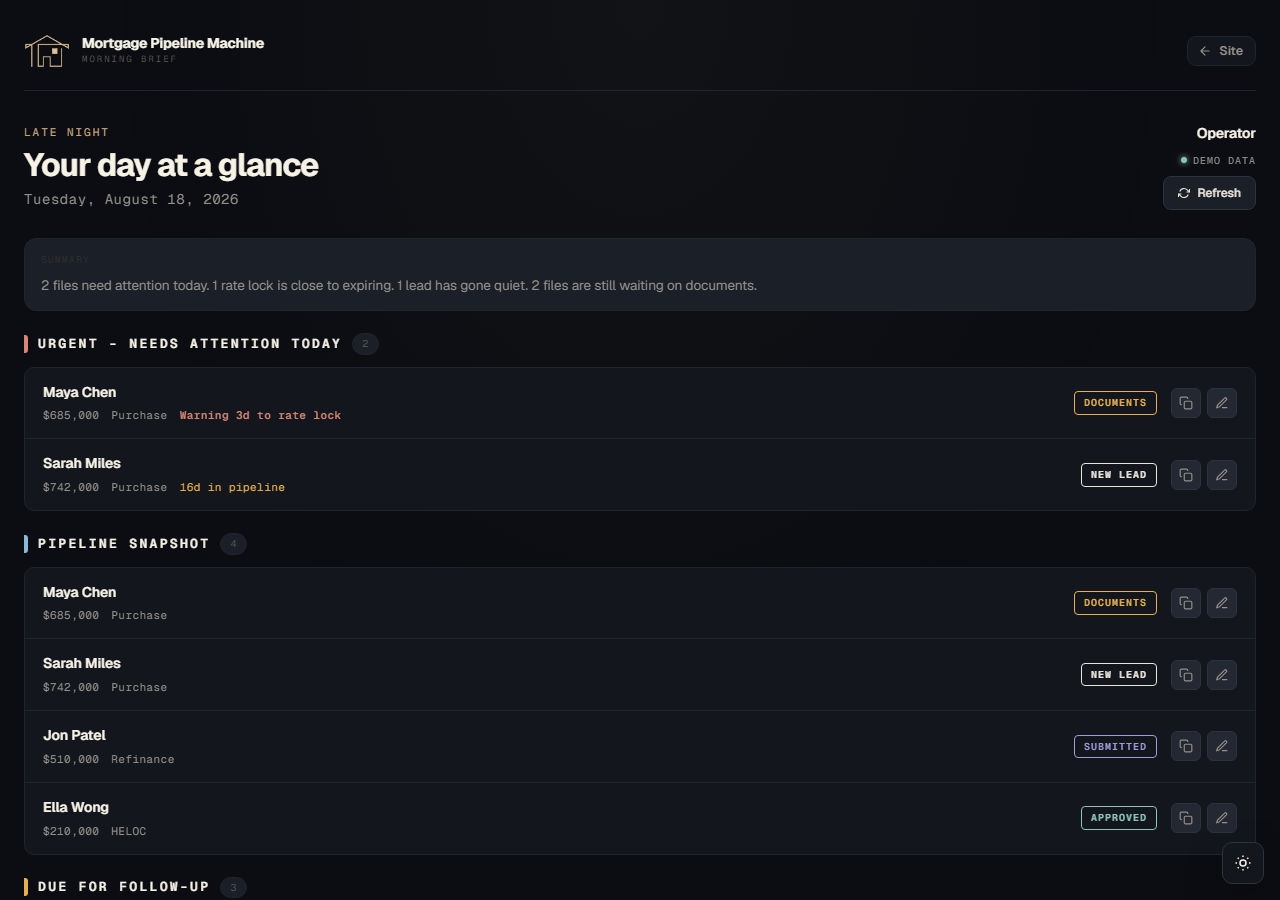
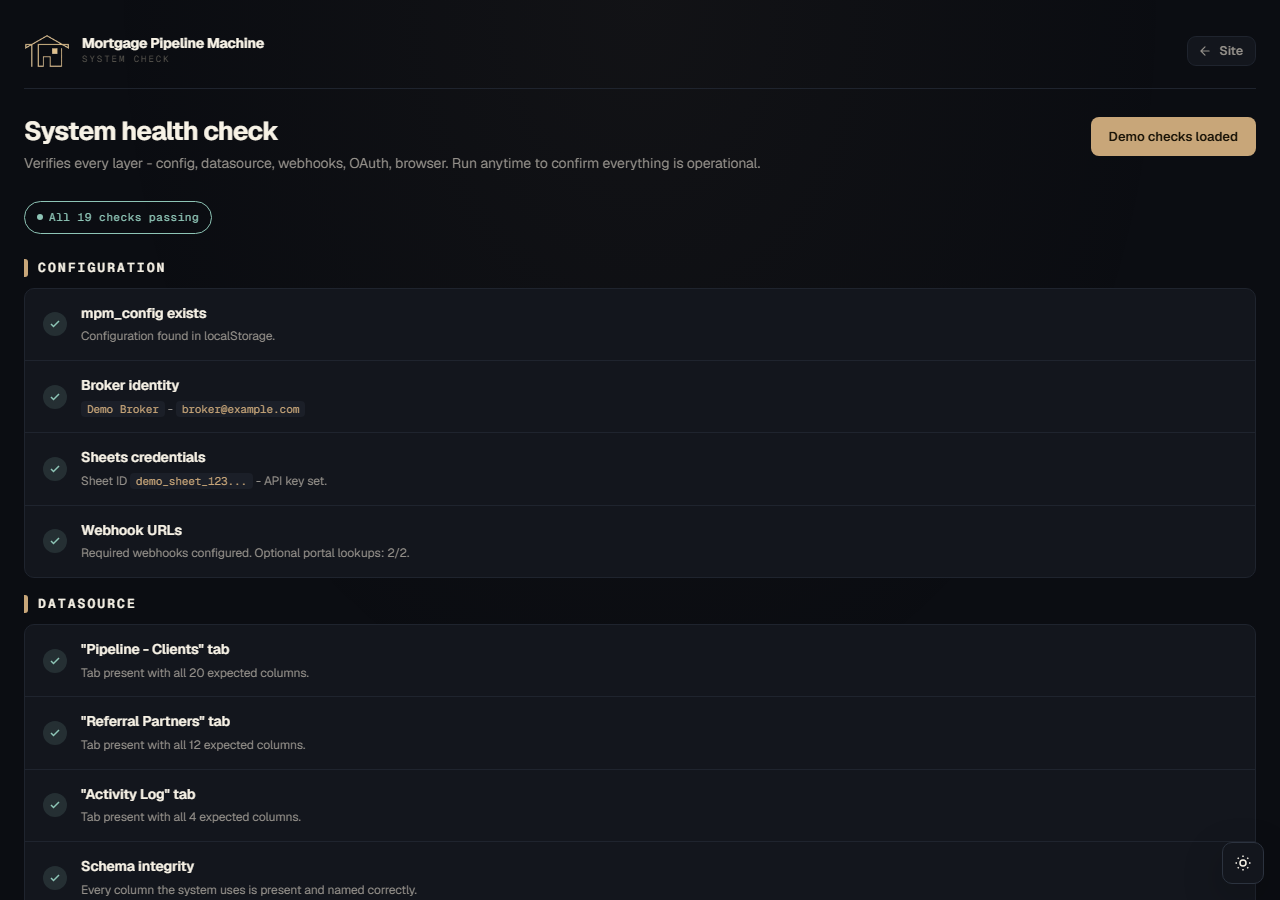
Use your own numbers. Estimate funded clients approaching renewal, average mortgage size, and expected commission. Want to see the workflow before sharing borrower data? Book a sample-data demo first.
Estimate what one recovered file, renewal, or referral relationship could be worth.
Calculate my hidden renewal opportunityPayment, CMHC, stress test, rate sensitivity table. Shareable URL.
OpenIncome to purchase price with GDS/TDS, stress test, scenario grid.
OpenSide-by-side 2-4 options. Total interest, stress test, recommendation.
OpenThe system is fast where speed is safe and deliberately slow where it is not. AI helps draft and summarize; rules control timing, consent, and evidence. Your broker remains the approval boundary.
A row without a renewal date, close date, or term is flagged for repair at the source. No default five-year assumption, no invented timing — a guessed date is a wrong plan delivered with confidence.
The Activity Log records requested, completed, skipped, suppressed, and failed — as what they were. A failure recorded as a success is the one bug this system refuses to have.
MPM uses AI where language work saves time and explicit rules everywhere a wrong assumption can cost you.
MPM is configured around the book and systems you already use. Your total involvement: roughly 6 hours across one week.
30-minute call to confirm fit, review your renewal process, agree on scope, and identify which records need to be checked first.
We configure MPM around your existing records, run the first coverage baseline, create the action-plan structure, connect the required workflows, and stand up your private access. You do not touch the technical setup.
We test renewal detection, priority rules, weekly action lists, reporting views, and follow-up paths with synthetic data. If anything is yellow or red, it gets fixed before launch.
60-minute screen-share. We walk through the renewal action list, dashboard, reporting view, and weekly operating rhythm. Your team drives for the second half.
You run the first real renewal action list. The system refreshes opportunities in the background from that point on. Two weeks later we have a 15-minute check-in. A month later we have your first monthly review.
We do not guarantee borrower decisions, closed renewals, or commission revenue. We do guarantee the implementation work we control: building, testing, and verifying the renewal action list and supporting workflows before you rely on them.
Every MPM plan includes the core system designed to help surface and work more of the opportunities already sitting inside your book.
You are not paying more just to unlock the features that make MPM useful. Plans scale primarily with the size of the book, operating volume, number of users, and complexity MPM is managing.
Start with the capacity that fits your operation today. Move up when your book or team outgrows it. No CRM replacement required.
We do not want the entry plan to be a watered-down version of MPM.
Every paid plan includes the core workflow required to surface opportunities, identify exceptions, and give the broker a clear action layer around the book they already use.
Your CRM stores the book. MPM helps make sure the opportunities inside it actually get worked.
No surprise overages. If your book or operating requirements outgrow your current plan, we discuss the next tier with you before your price changes.
The full core recovery system for established independent brokers with a smaller book.
Best for established independent brokers who want MPM working around their existing book without paying for unnecessary team capacity.
See if Solo fits my bookMore capacity and operating depth for brokers running a larger or more active book.
Same core recovery engine. More capacity. More operating depth.
Best for established brokers who have enough volume that MPM is becoming part of the weekly operating rhythm of the business.
See if Pro fits my bookHigher-capacity recovery infrastructure for multiple brokers, books, and team workflows.
Best for brokerages that need the recovery process operating across multiple brokers, books, or higher-volume workflows.
Map my brokerage requirements| Plan detail | MPM Solo | MPM Pro | MPM Brokerage |
|---|---|---|---|
| Core recovery engine | Included | Included | Included |
| Renewal detection | Included | Included | Included |
| Stale-file detection | Included | Included | Included |
| Missing-doc flags | Included | Included | Included |
| Consent / suppression holds | Included | Included | Included |
| Weekly action priorities | Included | Included | Included |
| Broker-reviewed workflow | Included | Included | Included |
| Activity tracking | Included | Included | Included |
| Reporting | Core reporting | Expanded where supported | Brokerage/team where supported |
| Book capacity | Smaller books | Higher capacity | Custom / highest capacity |
| Workflow capacity | Standard operating capacity | Higher recovery volume | Custom / highest workflow volume |
| Users | One primary broker/user | Individual / expanded where supported | Multiple brokers/users where supported |
| Team controls | Individual | Individual / expanded where supported | Brokerage / team |
| Support | Standard | Priority | Priority / higher-touch |
| Monthly price | $1,200-$1,500/mo based on funded-book size | $2,000/mo | $3,000+/mo |
| Implementation | $1,000 one-time | $1,000 one-time | From $1,000 |
Larger books create more opportunities, more exceptions, and more ongoing processing.
Higher-volume operations require more recovery activity and exception handling.
Solo brokers do not need the same infrastructure as multi-broker teams.
Higher tiers receive more operational depth and higher-touch support.
The recovery mechanism stays consistent. What changes is how much MPM needs to manage.
You should not have to upgrade just to make MPM useful. Upgrade when your operation genuinely needs more capacity.
Your $1,000 implementation gets MPM configured around the book and workflow you already use, including validation, recovery baseline, exception mapping, workflow configuration, operating-rule configuration, initial environment setup, first action-priority setup, and launch support.
It is not simply an account-activation fee.
The economics of MPM depend on the amount of opportunity already sitting inside your book.
A broker with a mature funded book has a very different recovery opportunity than someone who has only recently started building one. That is why we look at book size and operating volume before recommending a plan.
We would rather put you on the plan that fits your book than sell you capacity you do not need.
MPM is not automatically a fit for every mortgage broker.
The economics depend on the size of your book, the opportunities entering the pipeline, and what a funded transaction is worth to your business.
Before recommending a plan, we want to understand whether there is enough opportunity in the book to justify the investment. If the economics do not make sense for your book, we will tell you.
Illustrative only. MPM does not guarantee a specific number of renewals or revenue outcomes.
Because the problem is ongoing. Your book changes every week.
New clients enter renewal windows. Files go stale. Documents go missing. Follow-ups become due. Consent and suppression statuses change. Referral partners need attention. Priorities shift.
MPM's ongoing value is helping your team keep working those gaps after launch.
The implementation configures the operating layer. The subscription keeps that layer running around the book.
MPM is not trying to become another CRM.
Your CRM stores the book. Your spreadsheet may organize the data. MPM adds the recovery and action layer around that existing process.
If your current systems already do all of this reliably every week, you may not need MPM.
Your CRM stores the book. MPM helps make sure the opportunities inside it actually get worked.
Borrower data remains in the brokerage's Google Workspace / canonical workbook. MPM stores only the operating and configuration information needed to run the service.
The brokerage keeps the final approval boundary. MPM can flag, sort, prioritize, draft, and automate only inside approved rules.
If consent is missing, unclear, revoked, suppressed, do-not-contact, or conflicting across records, outreach is blocked and the record becomes a review item.
Track consent status, source, review timestamps, suppression state, and workflow activity so the brokerage can see why an item moved or was held.
The first demo can run entirely on sample data. You can see book upload and cleanup, renewal priorities, stale-file detection, missing-document flags, consent holds, suppression holds, borrower detail view, and the weekly action list without handing over your real client book.
No borrower data required for the first demo.
We will look at the broad shape of your book and operating process, show you MPM using sample data, and help determine which level of capacity makes sense.
If the economics do not make sense for your book, we will tell you.
No borrower data required for the first demo.
MPM supports operational compliance workflows. It does not replace the brokerage's legal, regulatory, or compliance obligations.
Book a fit call. We will look at the book you actually have — size, coverage posture, consent posture — and tell you honestly whether MPM earns its retainer on it. If it does, you will see the exact recovery plan it would run.
Find the leaks in my book